
The $147 million plan that doesn’t add up
Council’s Moss Vale Road North contributions plan gets the strategy right and the document wrong.

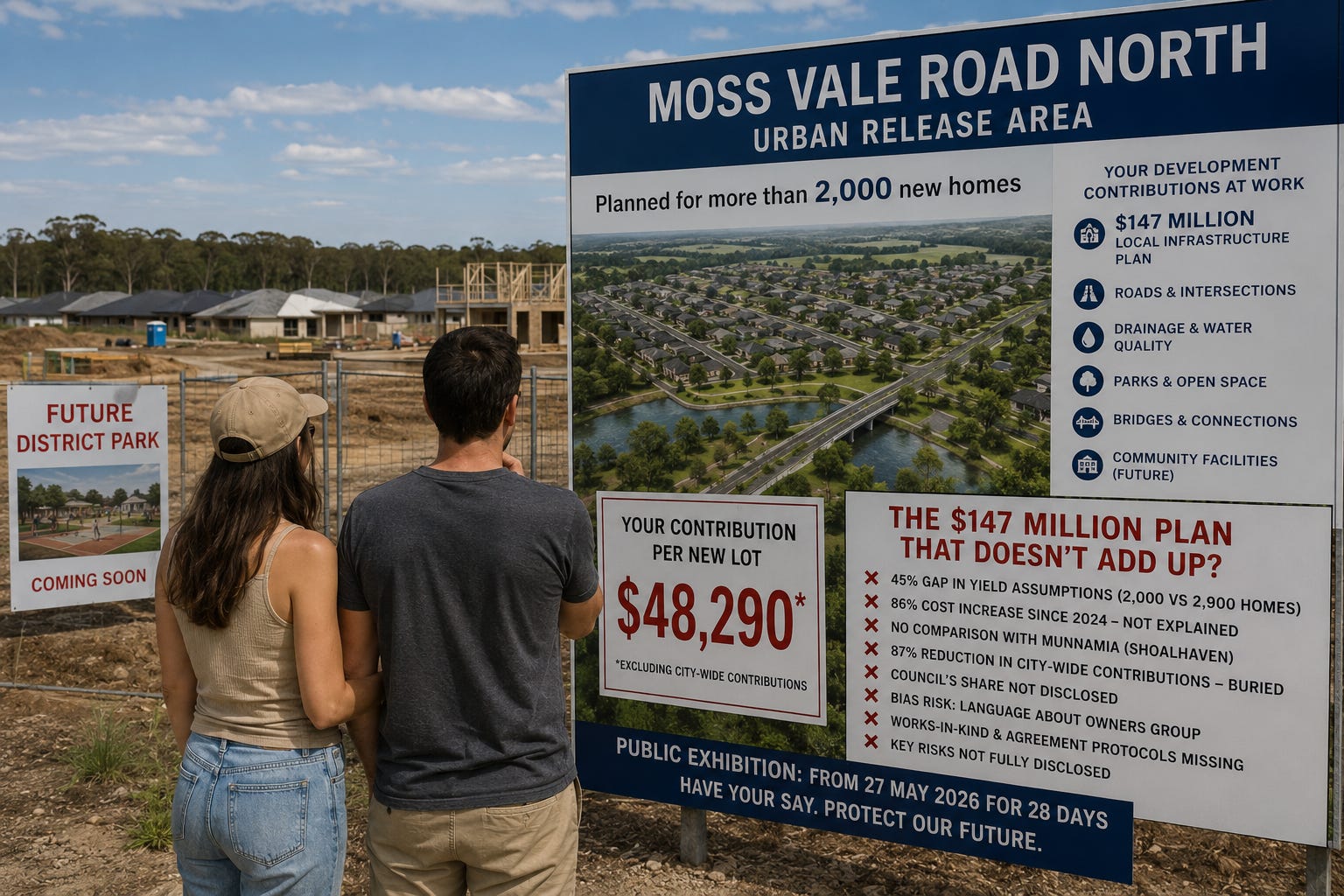
AI-GENERATED IMAGE (ILLUSTRATIVE): This is a digitally created image used for commentary. It is not a real photograph and does not depict an actual event or conduct. Any resemblance to real people is used for identification only; no factual claim is implied. If you are depicted and have concerns, contact me and I will review or remove it.
Imagine a young Bomaderry couple in 2028 walking through a half-finished cul-de-sac in the new Moss Vale Road North estate, looking at the block they have just bought.
The roads are graded but unsealed.
The drainage basin is fenced off.
The bridge that connects them back to Bells Lane is in the planning brochure but not in the budget.
The district park with the multi-sports court is somewhere five years away.
They paid $48,290 in development contributions on top of the block — every cent of which was supposed to fund exactly the things they cannot yet see.
Whether that scene is the worst-case caricature or the realistic outlook depends on a document Council is preparing to put on public exhibition.
On Tuesday 26 May, Councillors will be asked to endorse the draft Local Infrastructure Contributions Plan for the Moss Vale Road North Urban Release Area, a $147 million funding framework that will govern more than 2,000 — possibly 2,900 — new homes in the Nowra-Bomaderry corridor over the next ten to fifteen years.
The strategy in that document is largely right.
The execution is not.
Read closely,
the report contains a 45 percent gap between its own yield assumptions,
an 86 percent cost increase since 2024 that is never explained,
a deeply relevant comparison to Mundamia that is never mentioned,
a buried 87 percent reduction in city-wide contributions, and two sentences about the developer group that could expose Council to a bias challenge in any subsequent appeal.
None of those issues is fatal. All of them are fixable before exhibition begins. They should be fixed.
What the report does well — start here
Before the criticism, the credit. The strategic logic of CL26.111 is sound, and that matters.
A Contributions Plan is the right mechanism for capturing development-driven infrastructure costs. The alternative — letting development proceed without a plan — would shift the cost onto existing ratepayers, exactly the outcome the AEC Financial Sustainability Review warned against in 2023 and exactly the financial position Council has been working its way out of ever since.
Staff have followed the canonical sequence required under NSW planning law:
a 2024 Discussion Paper,
a 2025 Development Control Plan with a six-month deferred commencement, and
now a draft Contributions Plan for exhibition.
The Plan is supported by professional advice from GLN Planning, which is the leading NSW contributions consultancy, and Lindsay Taylor Lawyers, which is the leading NSW planning-agreements firm. The use of IPART industry benchmarks for cost estimation is industry standard and legally defensible.
The recommendation to apply to IPART after public exhibition is also correct. At $147 million across 2,000–2,900 homes, the per-dwelling contributions exceed the NSW Government’s $30,000 cap on local infrastructure contributions, and the only legal pathway to charge above the cap is independent assessment by IPART.
At least thirteen NSW councils have used that pathway. Refusing to apply for it would either cap the infrastructure delivered (producing a worse community) or shift the funding gap back onto ratepayers (producing a bigger general-fund problem). The pathway is the right call.
The urgency is real, too.
NSW case law confirms that Council cannot refuse development consent solely because a contributions plan is missing, which means each development application lodged in the interim risks crystallising infrastructure obligations without funding. Two DAs have already been lodged in the URA. Others are in preparation. The cost of doing nothing is measured in millions of dollars of Council exposure per parcel.
So what is the problem?
The problem is the document.
A defensible strategy is being marketed in a report that gives both the community and IPART grounds to question it on quality, transparency, and tone.
The risk is not that Council loses the IPART process.
The risk is that it
wins less of it than it could,
accepts more risk than it needs to, and
arrives at finalisation with a Plan less robust than the comparable plans Hills Shire, Penrith and Wollongong have managed to land in the last three years.
Issue one: a 45 percent gap between two yield numbers in the same document
The Background section of the report tells the reader that the URA “is forecast to deliver more than 2,000 new homes over the next 10-15 years.”
Three pages later, the contribution calculation table is described, in the same document, as being “based on assumptions for yield (2,900 new homes).”
That is a 45 percent difference, and per-dwelling contributions are inversely sensitive to yield. If the URA actually delivers 2,000 homes rather than 2,900, the contribution rate per new residential lot does not stay at $48,290. It rises to closer to $70,000.
At that level the plan starts to look unaffordable, developers begin gaming yield down to lower their per-lot exposure, and the funding shortfall lands back on Council. If the URA delivers 2,900 homes the figures are as published. If it delivers somewhere in between the figures are wrong by an unknown amount.
Neither yield number is sourced in the document.
There is no sensitivity table at 80, 100 and 120 percent of central case.
There is no statement of which figure is the working assumption for the contribution calculation.
There is no commitment to update the Plan if yield underperforms in the early phases.
This is the single most material weakness in the report, and it is the one that will not survive an IPART information request or a competent submission from any of the development interests in the URA.
It needs to be fixed before public exhibition begins on Wednesday 27 May. Picking a yield figure, disclosing the basis, and publishing a sensitivity table is a one-day piece of work for the team that built the schedule. Going to exhibition without it invites every objection the report is otherwise trying to head off.
Issue two: an 86 percent cost increase that is never walked
The 2024 Discussion Paper indicated infrastructure costs of $79 million.
The 2026 draft schedule is $147 million.
That is an 86 percent increase in two years.
The report attributes some of the rise to the expansion of the “satisfactory arrangements” through the 2025 DCP —
collector roads going from 3.9 kilometres to 7.7 kilometres,
additional intersection treatments,
a shared path network,
five bridges,
drainage infrastructure including a wetland and
eleven bio-retention basins, and a district park — and to “refinements from industry benchmarks, contemporary land valuations.”
None of those components has a dollar figure attached.
A reader cannot tell what proportion of the $147 million
is attributable to scope expansion,
what is attributable to indexation,
what is attributable to land valuation uplift,
what is the 40 percent contingency on top,
what is the 1.5 percent administration allowance, and
what is the 5 percent just terms compensation allowance for land acquisition.
Industry practice in comparable exhibitions — Hills Shire’s Box Hill, Penrith Northern Gateway, Wollongong West Dapto — is to publish a one-page cost-walk from the prior to the current draft, by infrastructure category, with dollar deltas. That single page would do more to defuse the consultation conflict than any of the staff comments in the objection-response table.
Without the cost-walk, the Owners Group’s allegation that the IPART pathway is being deliberately triggered, which appears as objection point three in the report, is harder to dismiss than staff want it to be.
The right response to that allegation is not a paragraph of paraphrase. It is a line-item bridge from $79 million to $147 million that lets the reader see, item by item, what was added, what was indexed, and what was estimated. The information exists. It needs to be in the document.
Issue three: the Mundamia comparison the report does not make
The report names three comparator councils that have taken the IPART pathway to charge above the $30,000 cap:
Penrith at $107,000 to $137,000 per dwelling,
Blacktown at $85,000 to $120,000, and
Wollongong averaging $80,000. Those numbers are accurate. They are also the wrong comparators.
Penrith and Blacktown are Sydney-basin release areas with substantially higher dwelling yields per hectare, higher land values supporting the contribution base, and trunk infrastructure obligations — regional roads, major intersections, sub-arterial drainage — that make the per-dwelling cost optically large but proportionate to the development context.
Wollongong’s average masks very different rates between West Dapto and the smaller infill sites.
Comparing a rural-edge release outside Nowra to those Sydney-basin areas without flagging the density and yield differences is misleading.
The right comparators for Moss Vale Road North are regional NSW release areas with similar yields and contexts — Wingecarribee, Eurobodalla, Kiama, perhaps Wagga Wagga’s Boorooma and Estella, or the more recent Yass Valley releases.
The most useful comparator of all is one Council owns and the report does not mention: Mundamia, the Shoalhaven URA whose cap was just increased from $20,000 to $30,000 per dwelling by Ministerial decision.
The Mundamia precedent is referenced in the parallel CL26.110 Shoalhaven Contributions Plan 2026 report on the same agenda, which notes that “a formal request has now been presented by DPHI to the NSW Minister of Planning and Public Spaces, to increase the cap (maximum amount Council can charge per dwelling or new residential lot) from $20,000 to $30,000.”
Same council, same growth-area framework, same governance process, recent decision. Its omission from the comparator list in CL26.111, while citing Sydney-basin release areas at three to five times the relevant scale, reads as comparator selection rather than comparison.
If Mundamia at $30,000 is what the Minister has just been prepared to approve, the right framing for Moss Vale Road North is not “Penrith charges $137,000” — it is “the Minister approved $30,000 for Mundamia; we are asking IPART for assessment at higher levels because the infrastructure schedule for Moss Vale Road North includes [specific items] that Mundamia does not require.” That framing is harder to write. It is also the framing IPART will be looking for.
Issue four: an 87 percent City-wide contribution cut, buried in one sentence
Page 80 of the agenda, three lines down from the top of the recommended approach section, contains a sentence that deserves three pages and gets one:
City-wide Development Contributions have been reduced from circa $9,000 per dwelling charged under the current City-wide Development Contributions Plan to $1,195 per dwelling to ensure alignment of infrastructure projects with the NSW Government’s essential works list and the proposed new City-wide Contributions Plan.
That is an 87 percent reduction in the City-wide contribution payable by every dwelling in Moss Vale Road North.
Spread across 2,900 homes it represents an absolute reduction of roughly $22.6 million in contributions to citywide infrastructure — bike paths, libraries, regional open space, sports facilities, the kind of infrastructure that benefits Shoalhaven residents beyond the URA itself.
The stated reason is policy compliance. The NSW Government’s essential works list, established under the cap framework, restricts the kinds of infrastructure councils can collect contributions for. Aligning Council’s City-wide plan to that list is sensible.
The question the report does not answer is what happens to the $22.6 million of city-wide infrastructure that was previously expected to be funded by Moss Vale Road North contributions.
It either gets dropped, gets pushed into the General Fund (paid for by every ratepayer in Shoalhaven), gets shifted to other URAs, or gets shifted into the local schedule for Moss Vale Road North itself — which then needs IPART approval to charge above the cap. There is no equivalent buried policy decision in the comparable Penrith or Wollongong contributions plans of recent years.
The community is entitled to see that transfer named, quantified, and explained. Three lines in a $147 million report is not adequate disclosure for an 87 percent policy reduction.
Issue five: Council’s own share, not disclosed
The report says, in the Financial Implications section, that Council is at financial risk “from the need to fund the delivery of more than an equitable share of the infrastructure.” It does not say what Council’s equitable share is.
Industry convention for citywide-benefit elements — some bridges, some intersections that serve external traffic, parts of the road network that connect to the existing grid — sits between 5 and 15 percent of works value, recoverable from general revenue or apportioned to wider catchments.
On $147 million, that is between roughly $7 million and $22 million of General Fund exposure.
The actual figure may be different.
The community has no way of knowing because the report does not disclose it.
That is a meaningful gap.
The same council whose current-year General Fund deficit is being managed down from $14 million to $9.8 million through, in part, salary savings and deferred capital is taking on infrastructure obligations that may carry tens of millions in residual ratepayer exposure over the next twenty years. The number is knowable.
Council’s strategic transport, drainage and open-space teams have already apportioned the works between development demand and citywide benefit; that apportionment is how the developer share was calculated in the first place.
Publishing it would not weaken Council’s negotiating position. Withholding it makes the report harder to assess and easier to challenge.
Issue six: two sentences that should not be in a public Council report
Two sentences in CL26.111 will give a planning lawyer pause. The first appears in the External Consultations section:
Disappointingly, the Owners Group provided what essentially amounts to a formal objection on 7 April 2026.
The second appears immediately below the objection-response table:
Council staff have tried to collaborate with the Owners Group over many years, and this has often been challenging, problematic and a level of agreement has not been possible that meets their expectations/desires.
Those sentences do not belong in a Council report being exhibited to the public and prepared for IPART scrutiny. They are characterisations of an identifiable stakeholder group, written in language that imputes unreasonableness without evidence.
If the Owners Group subsequently seeks judicial review of any aspect of the consent process — and major developers do this routinely — those sentences become Exhibit A in a bias argument.
Neutral language accomplishes the same disclosure without exposing Council. “Engagement since March 2025 has not produced agreement on the scope and design of local infrastructure. The Owners Group lodged a formal objection on 7 April 2026, the grounds of which are summarised below.” That sentence does the work.
There is a deeper issue underneath the language. The Owners Group has, by the report’s own account, issued briefs to its consultants, produced alternative road, intersection and drainage designs, and submitted them in April 2026.
That is the kind of substantive engagement councils dream of from major developers. It is not what every URA gets. The report does not disclose which of the Owners Group’s inputs have been adopted in the draft schedule and which have not, or the dollar impact of either. Best practice in comparable plans — West Dapto Stage 2 was a recent clean example — is a concessions log that demonstrates good-faith engagement and undercuts bias allegations before they form. Its absence here is the single biggest fixable weakness in the consultation narrative.
What an improved document would look like
A version of CL26.111 ready for exhibition would do nine things this version does not:
• Reconcile the 2,000-versus-2,900 yield assumption and publish sensitivity tables at 80, 100 and 120 percent of central case.
• Provide a single-page cost-walk from $79 million (2024) to $147 million (2026) by infrastructure category, showing dollar deltas for scope expansion, indexation, contingency, administration allowance, and just-terms compensation.
• Disclose Council’s expected share of the $147 million and how it will be funded — General Fund, loan, grant, or apportioned to other catchments.
• Frame Mundamia and at least two regional NSW councils as primary comparators, with Penrith, Blacktown and Wollongong noted only for procedural reference.
• Quantify the City-wide contribution reduction from $9,000 to $1,195 per dwelling and explain where the displaced citywide-infrastructure cost is going.
• Publish a Works-in-Kind protocol and a Voluntary Planning Agreement acceptance protocol with thresholds, consistency tests and refund methodology.
• Expand the risk register to include construction-cost and land-valuation escalation, yield underperformance, Housing Delivery Authority porting risk by parcel, and IPART timing contingency.
• Replace the two pejorative sentences about the Owners Group with neutral disclosure language.
• Add a CFO endorsement of financial implications, and publish a stakeholder concessions log showing which Owners Group inputs were adopted and the dollar impact of each decision.
None of those nine changes weakens Council’s position. Several of them strengthen it for the IPART assessment that is the whole point of the exercise. All of them are within the capacity of the Strategic Planning team to deliver in the next two weeks. None of them requires Council to retreat from the IPART pathway, the $147 million figure, or the broader strategic approach. They simply require the document to do its own job.
What you can do
Tuesday 26 May, 5:30pm, Studio Room at the Shoalhaven Entertainment Centre. The Public Forum is open to residents who register through Council’s website in advance. The exhibition period itself, if endorsed on the night, will run for 28 days from later in the week and provides the formal opportunity to lodge a written submission.
• Ask the yield question. Why does the Background say more than 2,000 new homes while the contribution calculation assumes 2,900? Which figure is the working assumption, and what sensitivity has been modelled at 2,000 and at 2,500?
• Ask the cost-walk question. Will Council publish, before exhibition closes, a single-page reconciliation of the 2024 $79 million infrastructure cost estimate to the 2026 $147 million schedule, by infrastructure category?
• Ask the Mundamia question. Why does the comparator list cite Penrith, Blacktown and Wollongong but not Mundamia, which sits inside Shoalhaven LGA and has just had its cap approved at $30,000 per dwelling by Ministerial decision?
• Ask the City-wide question. Where does the $22.6 million of city-wide infrastructure obligation displaced by the reduction from $9,000 to $1,195 per dwelling actually land — in the General Fund, in other URAs, or removed from the program?
• Ask the share question. What is Council’s expected share of the $147 million, and how will that share be funded?
• Write a submission during the 28-day exhibition. Submissions in writing carry more weight than verbal addresses at the Forum because they go on the formal record and into the IPART information set. Two pages naming the agenda item (CL26.111) and identifying the issues above is more than adequate.
Moss Vale Road North will reshape the Nowra-Bomaderry corridor over the next decade and a half. The community that ends up living there has a stake in this plan being right, and so does every existing ratepayer whose general revenue is on the hook for whatever the plan fails to capture.
The strategic posture in CL26.111 is defensible and the IPART pathway is the correct call. The document itself is not yet fit for the exhibition it is asking for.
Local infrastructure plans are technical documents.
Their consequences are not.
The decisions taken in the next two weeks will be in the rate notice for the next twenty years, and in the parks, roads and bridges that the people moving into Moss Vale Road North will use or fail to use depending on what is funded. Council is owed an honest hearing.
It is also owed an honest document. Both are achievable.
Sources
• CL26.111 — Preparation of Local Infrastructure Contributions Plan for Moss Vale Road North Urban Release Area; and Attachments 1–3 (draft Plan, DCP Figure 3, Owners Group Objection of 7 April 2026), Shoalhaven City Council Ordinary Meeting agenda, 26 May 2026.
• CL26.110 — Finalisation: Shoalhaven Development Contributions Plan 2026, same agenda.
• CL26.93 — Draft Delivery Program Operational Plan and Budget 2026-27: Public Exhibition, Extraordinary Meeting 30 April 2026.
• GLN Planning advice to Shoalhaven City Council and Lindsay Taylor Lawyers advice, as referenced in CL26.111.
• IPART industry benchmarks (Genus Advisory, Evans & Peck, Stantec) — methodology for assessing local infrastructure contributions above the NSW Government cap.
• AEC Financial Sustainability Review, November 2023; NSW Environmental Planning and Assessment Act 1979; NSW Government Housing Delivery Authority pathway.
• “The ‘Phenomenal Turnaround’ That Isn’t: Reading Shoalhaven’s Budget Honestly” — Steve Prothero/Substack.
• “The fuel bill that isn’t there” — Steve Prothero/Substack.
Please share this with 2 friends who care about Shoalhaven.
Donations to help keep the show afloat and pay for GIPA and legal costs
If you get value from this post and you want to help me with information applications to get to the bottom of issues, you can donate here.
Thank you for considering this, the posts will always be free - but I could do with some help :)
Want to understand how councilCode of Conductcomplaints really work?
I’ve released a plain-English PDF guide to help residents understand when a complaint is appropriate, who it should go to, what evidence is needed, and what mistakes to avoid.Buying the guide also helps fund Eye on Shoalhaven Council by contributing to the software, research and publishing costs behind the work.
Learn the process. Support independent local scrutiny. Available here:
https://4917955029345.gumroad.com/l/ycxrkd
Want to understandhow to use GIPA to request council information?
I’ve released a plain-English PDF guide to help residents understand when to make a GIPA application, how to ask for the right documents, what timeframes and fees apply, and what to do if access is refused.
Buying the guide also helps fund Eye on Shoalhaven Council by contributing to the software, research and publishing costs behind the work.
Learn the process. Support independent local scrutiny. Available here:https://4917955029345.gumroad.com/l/oaazmv
GIPA - information you have paid for or you are supporting me with
Here are the current applications to council, seeking documents. At the moment I have one matter before NCAT. I will fight for transparency.
Defamation
Disclaimer: This article provides analysis and commentary based on publicly available information and council transcripts. It does not make allegations of misconduct by any individual. Readers should verify details independently before drawing conclusions.
Use of AI
Here is a quick disclaimer, or explainer on the use of AI in the Eye.
Contact links for the Council
I encourage you to take up your democratic right and engage with councillors, here are the contact details - send them questions or comments, text is best as they tend to ignore emails.Here is the link to the contact information.
Questions you can ask the Mayor at meetings or if you see her!
Here are some questions community members have submitted that you can use if you’re at a public meeting with the Mayor. Please keep your question polite and to the point, and if you get an answer, follow up afterwards in writing to confirm what you heard and reduce any “misunderstanding” later. Then let the Eye community know what she said so we can keep a shared record. Here’s the link to the questions