
Reading Between the Lines: What the September Papers Tell Us About Shoalhaven Council
The papers from City Performance

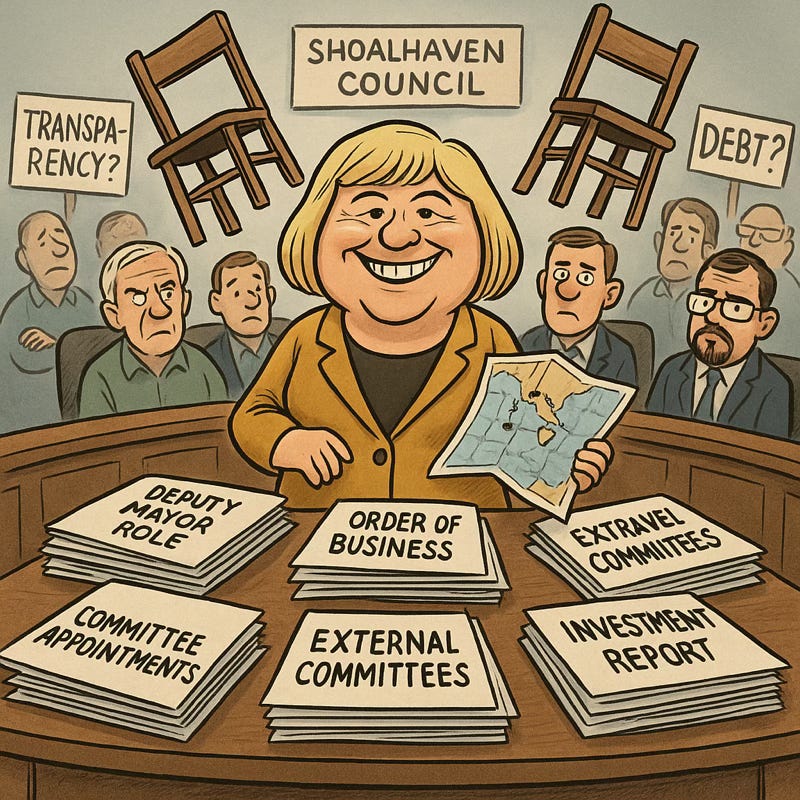
This is a summary of the group of papers from City Performance, if you want more detail of my view on the papers they can be found here.
At the September 23, 2025 Ordinary Meeting, councillors will consider a series of reports prepared by the Director of City Performance. At first glance, these papers look like routine governance housekeeping. But look closer, and you see the outlines of political strategy, risks to council’s bottom line, and opportunities being created for the Mayor’s profile — both inside and outside Shoalhaven.
CL25.300 – Election of Deputy Mayor and Assistant Deputy Mayor
This paper confirms the Deputy Mayor’s allowance arrangement is cost-neutral — the $10,000 is deducted from the Mayor’s fee . On its face, this is tidy governance.
But the creation of an Assistant Deputy Mayor role has no basis in the Local Government Act. It carries no statutory function, but provides a platform for political manoeuvring. In my personal opinion, this looks like a way to reward allies with titles rather than strengthen leadership. With Council under financial strain, these symbolic positions risk appearing tone-deaf to ratepayers.
CL25.301 – Determination of Date & Time of Council Meetings and Briefings
Here, Shoalhaven adopts the Model Code of Meeting Practice . The positives are clear:
No more confidential pre-briefings, a long-standing transparency concern.
Agendas released earlier to the public, giving citizens more time to scrutinise.
Public forums live-streamed.
This is a genuine step forward for open government. The risk is cultural: councillors could attempt to rebuild “off-the-record” influence channels. Governance rules are only as strong as the councillors who respect them.
CL25.302 – Ordinary Meeting: Order of Business
The updated Order of Business shifts public deputations to forums before the meeting . On the plus side, they’ll now be streamed live. On the downside, councillors may treat them as less central to decision-making.
The unchanged rule that Mayoral Minutes remain first on the agenda means the Mayor still has a tactical tool to shape debate. In my personal opinion, this preserves her ability to dominate the public narrative.
CL25.303 – Community Consultation and Committee System 2025–26
This report highlights Mayor White’s expanding role across internal committees :
Chair of the Financial Review Panel.
Member of the Affordable Housing Advisory Taskforce.
Observer on the Audit, Risk and Improvement Committee.
These roles give her visibility on housing, finance, and risk without always being directly accountable. They also let her control the council’s narrative: projecting financial prudence and social concern while limiting exposure if things go wrong.
CL25.304 – Council Representatives on Other Committees or Organisations Outside of Council
Here, the Mayor has positioned herself on the most strategic external bodies :
Illawarra Shoalhaven Joint Organisation (ISJO).
NSW Country Mayors Association.
South East Australian Transport Strategy (SEATS).
Nowra Riverfront Activation Taskforce.
These are the forums that provide regional profile, travel opportunities, and election branding. The likely annual travel allowance exposure from these roles is around $2,700 at $0.85/km .
In my personal opinion, these appointments show a deliberate political strategy: regional leadership optics for the Mayor, while leaving lower-profile committees to others.
CL25.305 – LGNSW Annual Conference 2025: Motions
Shoalhaven is sending seven motions to Sydney . Some — like calls for high-speed rail and more infrastructure funding — are broad “motherhood statements” that look good on paper but rarely change state policy.
Others are concrete: the $100 million FOGO waste transition cost and betterment funding for disaster recovery. These are real financial pressures for Shoalhaven.
Still, the staff report subtly shifts responsibility onto councillors, noting that motions came from a councillor briefing and that Clr Clancy drafted one herself. In my personal opinion, this looks like staff protecting themselves from criticism if the motions are dismissed as tokenistic.
CL25.306 – Investment Report: August 2025
On paper, investments returned 4.66% p.a., beating benchmarks . But much of this “success” was due to temporary factors — rates instalments and one-off grants hitting the bank.
The reality is less rosy:
Over 40% of “general” fund interest is legally restricted.
Only $592,474 remains unrestricted.
Investment returns are being used to patch internal reserves that have already been dipped into.
Falling interest rates are expected, meaning returns will shrink in future.
In my personal opinion, this report quietly confirms that Council is running on borrowed time and borrowed money, not sustainable surpluses.
The Bigger Picture
Taken together, these papers tell a story:
Positive: Structural reforms to meetings and transparency.
Neutral/Optical: Symbolic roles like Assistant Deputy Mayor.
Risky: Heavy concentration of committee roles around the Mayor, with political upside for her but reputational risks if outcomes fail.
Financially Fragile: Investment reports and FOGO costs reveal underlying weakness in Council’s financial model.
For the Mayor, this is about power, profile, and positioning. For ratepayers, it’s a reminder to keep asking: do these decisions serve the community first, or the political survival of those in charge?