
GIPA, Facebook, “weaponisation,” and the legal tools the law already gave councils
— and their critics

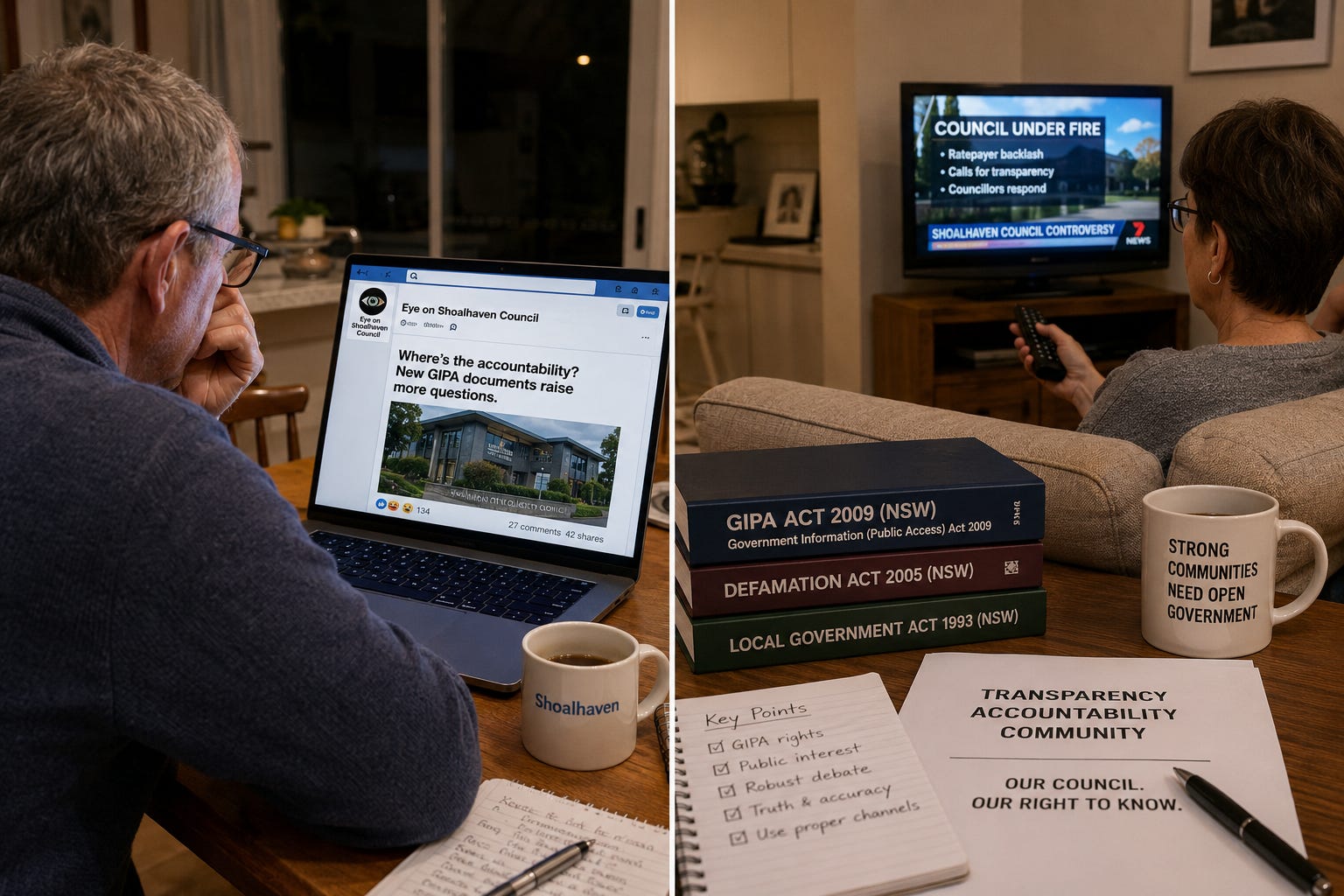
AI-GENERATED IMAGE (ILLUSTRATIVE): This is a digitally created image used for commentary. It is not a real photograph and does not depict an actual event or conduct. Any resemblance to real people is used for identification only; no factual claim is implied. If you are depicted and have concerns, contact me and I will review or remove it.
— — — — —
Picture two people on the South Coast on a Sunday night.
One is a councillor at a kitchen table with a laptop, scrolling Facebook after a long week. They have just read something sharp about a vote they cast and they feel the heat of it.
The other is a resident in their lounge room, half-watching the news, wondering whether they are allowed to say in public what they think about a council decision that affects their street. Both are anxious. Both are within their rights.
It is worth saying, plainly, that Australian law has thought about this problem for a very long time. There are well-developed rules about what residents can say about councils, what councils can do about residents, and where the boundary sits between robust democratic discussion and unlawful conduct.
Those rules already exist. They were written by parliaments, not invented on the radio.
This piece sets them out in plain English. It explains what the GIPA Act actually does, what the word “weaponisation” really means in this context, what councillors and staff can lawfully do when something untrue is said about them, and where the protected zone of democratic discussion ends.
It finishes with what the NSW Civil and Administrative Tribunal said about a particular Shoalhaven Facebook page — because the Tribunal has answered the question of where Eye on Shoalhaven Council sits on this map, and the answer is on the public-interest side of the line.
1. What the GIPA Act actually does
The Government Information (Public Access) Act 2009 (NSW) — the GIPA Act — replaced the old Freedom of Information regime in 2010. It was not built to be friendly to government.
It was built the other way round.
Three of its design choices matter most.
1. It starts with a presumption in favour of disclosure. Section 5 says government information must be released unless there is an overriding public interest against disclosure. The default is open. The default is not a favour granted by Council; it is a starting point Parliament chose.
2. It gives every person a legally enforceable right of access. Section 9 turns that presumption into a personal entitlement. You do not need to be a journalist, a ratepayer, a registered organisation or a degree-holder. You apply, the agency processes, and decisions are reviewable.
3. It defines, exhaustively, what a council may weigh against disclosure. The public-interest test in section 13 says government information must be released unless the considerations against disclosure outweigh the considerations in favour. Crucially, section 14 lists, in a closed table, the only considerations against disclosure that may be taken into account. They include things like prejudice to a deliberative process, risk of personal harm, prejudice to legitimate business interests, and a small number of other tightly drafted categories. They do not include the way information might be used after release.
Section 15 then sets out four hard rules about how the test must be applied.
Embarrassment to government is irrelevant.
Loss of confidence in government is irrelevant.
The possibility that information might be misinterpreted is irrelevant.
Disclosure cannot be made conditional on use.
Read together, those provisions tell residents something important.
If a council refuses an application, it must justify the refusal by reference to one of the listed considerations against disclosure, and then by reference to a balancing exercise that gives those considerations more weight than the considerations in favour.
It cannot refuse on the grounds that the information might end up on Facebook.
It cannot refuse on the grounds that the information might cause embarrassment.
It cannot refuse on the grounds that the applicant is critical of council.
None of those are statutory considerations.
2. The “weaponisation” claim — what it means in law, and what it does not
“Weaponising information” is a phrase that has crept into Australian local-government commentary in the last few years.
It sounds powerful.
It is rhetorical.
It is not, on its own, a legal concept under the GIPA Act, the Local Government Act, the Defamation Act, or any of the criminal statutes.
What people typically mean when they use it is one of three things, and each of those three things has a separate legal home.
· Sometimes “weaponisation” is used to describe critical commentary about councillors or staff that the speaker would prefer had not been published. That is not weaponisation. That is robust democratic discussion. It is squarely within the protected zone the Australian Constitution recognises through the implied freedom of political communication, and it is squarely within the defences the Defamation Act provides for honest opinion, truth, and qualified privilege on matters of public interest.
· Sometimes “weaponisation” is used to describe content that contains identifiably false factual statements about a person. That is defamation, and the Defamation Act 2005 (NSW) provides a complete and well-developed framework for dealing with it (see section 4 below).
· Sometimes “weaponisation” is used to describe behaviour that is genuinely abusive — repeated personal threats, image-based abuse, doxxing, intimidation, stalking. Each of these has a specific statute and a specific enforcement pathway (see section 5 below).
The reason precision matters here is that the three categories carry completely different legal consequences. Lumping them together under one banner — “weaponisation” — collapses important distinctions.
It also tends to chill the first category, which is the category the law is most concerned to protect, by treating it as if it were the third.
3. The protected zone — what residents may say about councillors
Australian law gives residents wide latitude to criticise people who hold or seek public office. Three layers of protection apply.
The implied freedom of political communication recognised by the High Court in cases including Lange v Australian Broadcasting Corporation (1997) 189 CLR 520 protects communication about government and political matters. Local government is squarely within its scope. Laws that effectively burden that communication must be reasonably appropriate and adapted to a legitimate end.
The statutory defences in the Defamation Act recognise honest opinion (s 31), truth (s 25), contextual truth (s 26), public documents (s 28), fair report of proceedings of public concern (s 29), qualified privilege for the provision of certain information (s 30), and the publication of matter concerning issues of public interest (s 29A — introduced in the 2021 amendments and modelled on the UK Reynolds defence). Each of these gives the publisher of comment about public officials genuine room to operate, particularly where the publication is fairly grounded and made in good faith.
The public-figure latitude recognised across the case law has long accepted that those who hold or seek public office must accept a higher level of public scrutiny than private citizens. That is not a loophole; it is part of the social contract on which elected office is held.
Within those layers, the things residents may lawfully do include:
criticise council decisions in pungent terms;
characterise the conduct of councillors as
poor judgement,
inconsistent,
secretive, or
politically motivated;
quote council resolutions and minutes;
publish analysis that draws unflattering inferences;
describe the work of councillors and senior staff as below the standard residents are entitled to
expect;
satirise;
campaign;
share documents that have been lawfully released.
Mass communication of this content via Facebook, Substack, X, community newsletters or a billboard outside the chambers is part of the same protected activity.
Robust democratic discussion is not, in law, a problem to be managed. It is the system functioning as designed.
4. Where the line is on defamation
The line is crossed when a publication contains a false statement of fact, communicated to at least one third party, that lowers a real person’s reputation, that is not protected by one of the defences above, and that has caused or is likely to cause serious harm to that person’s reputation. Each of those elements matters.
When that line is crossed, the law gives the affected councillor or staff member a defined and accessible pathway, set out in Part 3 of the Defamation Act 2005 (NSW). It runs broadly as follows.
4. The aggrieved person serves a Concerns Notice on the publisher under section 12A. The notice must specify the location of the matter, the imputations of which the person complains, and the harm caused.
5. The publisher then has 28 days to make an offer to make amends under sections 13 to 16. An offer to make amends typically includes a correction, an apology, removal of the offending material, and (often) compensation. If a reasonable offer is made and rejected, that becomes a defence to subsequent proceedings (s 18).
6. If the matter is not resolved, the aggrieved person may commence proceedings within 12 months of publication (or up to three years where extended), and must establish, among other things, that the publication caused or is likely to cause serious harm to their reputation (s 10A — the serious harm threshold introduced in the 2021 reforms).
7. The court may order damages, an injunction restraining further publication, and (in some cases) costs and aggravated damages. In serious cases, ongoing republication can be restrained.
That is the framework.
It exists.
It has been refined, repeatedly, by parliaments and by the courts over decades.
A councillor or a senior officer who believes that a publication contains false statements of fact about them, that the statements are not protected by any defence, and that those statements have caused or will cause serious reputational harm, has a real and proven legal pathway.
They do not have to invent a new vocabulary.
They do not have to take their grievance to the radio.
They serve a concerns notice and the process begins.
5. The line on harassment, threats and online abuse — and the tools that already exist
Some online conduct goes beyond commentary. Where it does, the law has specific tools, each with its own enforcement body. The most important of these for councillors and council staff are summarised below.
Cyber-abuse of an adult — Online Safety Act 2021 (Cth). The eSafety Commissioner can investigate adult cyber-abuse material — content that is intended to cause serious harm and that is menacing, harassing or offensive in all the circumstances. Where the threshold is met, the Commissioner can issue a removal notice to the platform or the end-user. Reports go to the eSafety Commissioner directly.
Image-based abuse — Online Safety Act 2021 (Cth). The non-consensual sharing of intimate images is unlawful and the eSafety Commissioner has direct removal powers and civil-penalty powers.
Threats and intimidation — Crimes Act 1900 (NSW). Section 545B (intimidation, watching and besetting) and the broader stalking and intimidation framework in the Crimes (Domestic and Personal Violence) Act 2007 (NSW) provide criminal pathways. A person who is being stalked or intimidated may also seek a Personal Safety Intervention Order (in NSW, an Apprehended Personal Violence Order under the same Act).
Threatening or menacing communications — Criminal Code Act 1995 (Cth), s 474.17. Using a carriage service (the internet, telephone, social media) to menace, harass or cause offence is a Commonwealth offence. The Commonwealth DPP and the AFP investigate and prosecute.
Bullying of council staff in their workplace — Fair Work Act 2009 (Cth). Council staff have access to the Fair Work Commission’s anti-bullying jurisdiction (Part 6-4B). The Local Government (State) Award also contains workplace dispute mechanisms.
Privacy — limited individual application. The NSW Privacy and Personal Information Protection Act 1998 applies to NSW government agencies; the Commonwealth Privacy Act 1988 applies to Australian government agencies and to specified large commercial entities. Neither imposes Privacy Act obligations on a private individual operating a personal Substack or Facebook page. The new statutory tort of serious invasions of privacy in the Commonwealth Privacy Act 1988 (Part IIIE, commencing 2025) can apply to individuals, but only for intentional or reckless serious invasions involving misuse of private information or intrusion upon seclusion — a very high threshold.
GIPA’s own restraint mechanism — Government Information (Public Access) Act 2009 (NSW), s 110. Where an agency genuinely believes a particular applicant is using GIPA in a vexatious manner, the Act provides a formal pathway: the agency can apply to NCAT for a restraint order limiting that applicant’s ability to make further access applications without approval. This is the lawful, transparent, evidence-tested mechanism for the problem an agency might describe as “weaponisation.” It is rarely used because the threshold is genuine; agencies have to prove the case on the evidence to a tribunal member, not assert it on commercial radio.
Code of Conduct — Local Government Act 1993 (NSW) and the NSW Model Code of Conduct. Members of the public can lodge Code of Conduct complaints against councillors. Councils can lodge complaints against members of the public who breach the Code in their dealings with council officials. The procedures are public, written, and reviewable.
OLG and IPC oversight. The Office of Local Government can investigate council conduct under section 430 of the Local Government Act. The Information and Privacy Commission can review GIPA decisions on its own initiative or on application. Both have formal processes that produce documented outcomes.
Read together, that is a substantial body of law.
Whatever else can be said about the protections available to elected officials and senior staff in 2026, it cannot fairly be said that they are unprotected, or that they have no recourse, or that public commentary about their work places them in a position of helplessness against which only extra-statutory framing on commercial radio can defend them.
6. What the Tribunal said about Eye on Shoalhaven Council
The proper place to test where a particular person and a particular publication sit on this map is in the bodies that exist to make those findings — including, on a GIPA matter, the NSW Civil and Administrative Tribunal. In Prothero v Shoalhaven City Council [2026] NSWCATAD 123, a decision delivered by Senior Member M Riordan on 4 May 2026, the Tribunal addressed exactly this question in respect of a particular Shoalhaven page. The reasoning is on the public record. Three passages are directly relevant.
First, on the purposes of the GIPA application made through the page (paragraph 10):
“the applicant’s express motive of understanding matters of potential corruption and misconduct within it and/or promoting transparency, ensuring public accountability and supporting the community’s right to be informed about the integrity of its local government, is a consideration in favour of disclosure of government information. These considerations were each given strong weight.”
Second, on the special public benefit of release, including release through a community publication (paragraph 70):
“In addition to the general presumption in favour of disclosure of Government information and the examples set out in s 12(2) of the GIPA Act, the respondent identified that there is a special benefit to the public as it promotes transparency, ensures public accountability and informs the community about the integrity of its local government.”
Third, on the role of the Facebook page itself (paragraphs 71–72):
“The respondent also considered the applicant’s personal factors in making the application, which include his role as administrator of a Facebook page – ‘Eye on Shoalhaven Council’ … The respondent afforded each of these considerations strong weight and I agree with that assessment.”
Read in plain English, that is a Tribunal — on review —
agreeing that a particular Facebook page run by a particular Shoalhaven resident, on which council documents and council scrutiny are published,
is a public-interest activity that warrants strong weight when balancing for and against disclosure under the GIPA Act.
The Tribunal did not characterise the page as harassment.
It did not characterise it as intimidation.
It did not characterise it as misuse of statutory rights.
It did not say it was a “psychosocial hazard.”
It said the opposite. It identified the page as part of the proper democratic discussion that the GIPA Act is designed to facilitate.
That is the finding. It is on the record. It can be read at any time on the NSW Caselaw website.
7. Why the proper channels matter — for both sides
It might be tempting to read all of this and conclude that one side wins and the other side loses. That would be wrong. The proper channels protect both sides.
They protect the resident or community publisher from being characterised as a harasser without a formal finding to support that characterisation.
They protect the councillor or senior staff member from genuinely abusive conduct, with real removal and restraint powers and a clear evidentiary process.
They protect the wider community from a system in which decisions about who is or is not a problem are made on talk-back radio rather than in writing, on the record, by people accountable for those decisions.
Reaching for a microphone instead of reaching for a concerns notice is a choice. A councillor who feels defamed has the Defamation Act. A senior officer who feels harassed online has the eSafety Commissioner. A council that genuinely believes an applicant is misusing GIPA has section 110 of the GIPA Act and a tribunal hearing. Each of those bodies will weigh the evidence and make a finding. They produce documented outcomes the public can examine. Radio interviews do not.
8. The Shoalhaven setting
There is a reason this piece is being published now in the Shoalhaven and not somewhere else.
In the past fortnight, the Chief Executive Officer of Shoalhaven City Council has appeared on commercial radio and characterised a community Facebook page as
a “psychosocial hazard,”
has described the lawful exercise of statutory access rights as the “weaponising” of information, and
has described an NCAT decision in terms that are not consistent with what the Tribunal actually wrote.
None of those characterisations was preceded by a complaint, a defamation concerns notice, an application to NCAT under s 110 of the GIPA Act, an eSafety report, an AVO application, or any other formal process.
The pieces of this story have been covered separately on this Substack.
The point of this piece is broader. The legal tools described above are not theoretical. They were designed to be used. If the matters that have been raised on the radio cross any actual legal line, those tools are available.
If they do not cross any actual legal line, they sit within the protected zone of democratic discussion that the High Court, the parliaments, and the Tribunal in Prothero v Shoalhaven City Council have repeatedly recognised.
9. What both sides should take from this
If you are a resident of any LGA in New South Wales who is unsure whether you are allowed to criticise your council in public, the answer is:
yes, in robust terms, on Facebook, on Substack, in newsletters, at public meetings and through GIPA applications.
The protected zone is wide. Stay accurate, distinguish opinion from fact, attribute your sources, and you are operating within it.
If you are a councillor or council officer who feels that a particular publication has crossed the line, the answer is:
there are real tools available to you, and you should use them. Serve a concerns notice. Lodge a Code of Conduct complaint. Report to the eSafety Commissioner. Apply to NCAT.
Each of these mechanisms exists precisely so that contested questions of fact are decided in the proper place, with the evidence, in writing.
If you are an officer of council in a senior administrative position and you feel pressure from public commentary, the answer is the same as it has always been. The role is administrative, not political. Disagreement with criticism is not, by itself, a basis for public characterisation of named members of the public on commercial radio. The proper channels protect you. They are also there to protect the system from being short-circuited.
10. The bottom line
Robust democratic discussion is not weaponisation. The GIPA Act is not a favour. The Defamation Act is not for political grievances dressed up as personal ones. The Tribunal has spoken about Eye on Shoalhaven Council and what it found is on the record.
The line between protected and unprotected conduct is
well-mapped,
well-tested, and
well-resourced.
The state has spent decades drawing it. If a particular case crosses that line, the law has remedies — and they are remedies that, in being used, generate findings the public can examine and rely on.
If a particular case does not cross that line, it is part of the conversation a self-governing community is entitled to have about how it is being governed.
That is the conversation Eye on Shoalhaven Council exists to be a small part of, and it is the conversation a Senior Member of the NSW Civil and Administrative Tribunal has now confirmed is, in this case, a public-interest activity entitled to strong weight.
— — — — —
Sources and further reading
· Prothero v Shoalhaven City Council [2026] NSWCATAD 123 — NSW Civil and Administrative Tribunal, Senior Member M Riordan, decision 4 May 2026 (NSW Caselaw).
· Government Information (Public Access) Act 2009 (NSW) — in particular ss 3, 5, 9, 12, 13, 14, 15, 55, 58, 110.
· Defamation Act 2005 (NSW) — in particular ss 10A, 12A–18 (concerns notice and amends), and ss 25–31 (defences).
· Online Safety Act 2021 (Cth) — adult cyber-abuse and image-based abuse schemes administered by the eSafety Commissioner (esafety.gov.au).
· Crimes Act 1900 (NSW); Crimes (Domestic and Personal Violence) Act 2007 (NSW) — stalking, intimidation, AVO/APVO framework.
· Criminal Code Act 1995 (Cth), s 474.17 — using a carriage service to menace, harass or cause offence.
· Fair Work Act 2009 (Cth), Part 6-4B — anti-bullying jurisdiction of the Fair Work Commission.
· Privacy and Personal Information Protection Act 1998 (NSW); Privacy Act 1988 (Cth), including Part IIIE — statutory tort of serious invasions of privacy.
· Local Government Act 1993 (NSW); NSW Model Code of Conduct for Local Councils; Office of Local Government investigations under s 430.
· Lange v Australian Broadcasting Corporation (1997) 189 CLR 520 — implied freedom of political communication.
· Information and Privacy Commission NSW — guidance on the public-interest test and on s 110 restraint orders (ipc.nsw.gov.au).
Disclaimer
This article is general commentary written for residents of the Shoalhaven and a wider local-government audience in NSW. It is not legal advice. Anyone who is considering taking, or responding to, action under any of the statutes mentioned should obtain advice from a qualified Australian legal practitioner. References to recent Tribunal decisions are based on the published reasons available on NSW Caselaw at the date of publication.